Bounded calls
Every step receives a defined mission and only the context it needs.
Tandem / Governed session system
A single long chat drifts: context piles up, the brief blurs, and checking the result always lands back on you. Tandem moves work forward in bounded steps — production and review separate, decisions with you, everything on one inspectable record. What comes back is reviewed, not just finished.


Every step receives a defined mission and only the context it needs.
The model producing a step does not review its own work.
Decisions requiring authority stay with the person responsible.
State, evidence, findings and open work survive pauses and model changes.
Successive headless runs
Long work moves forward in bounded steps, not in one conversation that grows until it drifts.
A monolithic chat accumulates context indiscriminately, and with it the risk of drift. Tandem proceeds through successive headless executions: every mission is scoped, and the state of the work lives outside the model's context window.
The human states the intent, the expected outcome and the working constraints. The brief stays canonical for the whole session.
The runtime issues a bounded assignment to one role. The mission carries only the context that the step requires — not the accumulation of every previous turn.
A supported model executes the mission headless. Output, events and receipts come back to the runtime, not to a chat scroll.
The result is judged by a separated role, and the decisions that need human authority are brought to the human with the material required to decide.
The recorded state feeds the next bounded turn, or the session closes with its outcome, open items and evidence.
State outside the model
A pause, a restart or a new turn resumes from recorded facts.
Tandem keeps an append-only session history: plan revisions, human acts, results and findings are recorded once, with provenance, and never rewritten. The current state is derived from that history, so recovery resumes from the exact point the record reached — not from whatever a model happens to remember.
Personalities and roles
A session is a closed set of personalities working with a human. Each personality is a role with a competence, a mission and boundaries; which model executes it is a binding detail resolved at launch — never part of the role's meaning.
Semantic supervision of the whole workflow and the only channel to the human. Routes assignments, judges the adequacy of results and asks for corrections.
Turns the brief into one integrated plan with named responsibilities and dependencies. Does not certify the result.
Executes the assigned product work. Does not close its own steps.
Independent conformity judgement with a structured report and evidence. Does not modify the deliverable.
Proportioned checks on the concrete risk surface, with a structured report.
Additional independent verification when the work requires it. Findings must be corrected, refuted with evidence or brought to the human.
Brief, approvals, authorised revisions and exceptional closures. Not a node in the workflow: the authority.
Independent review
Production and review carry separate responsibilities.
The role that produces a result does not approve it. Review, proportionate risk assessment and challenge remain separate responsibilities, and each material claim is checked against defined criteria and supporting evidence before the work moves forward.
Canonical history
One record for what was due, decided, accepted, rejected, verified and left open.
Your models, your choice
Supported CLI families and direct provider APIs, chosen per role and per session.
Tandem works with the CLI subscriptions you already pay for — and connects directly to provider APIs when that serves you better. You choose per role, per session: use an API-only model like DeepSeek, reach Qwen or Grok without adding yet another subscription, go direct to the API when your plan's allowance runs out mid-work, or trial a model before committing to a plan. Your model mix stays your choice.
From a real session
Tandem Console
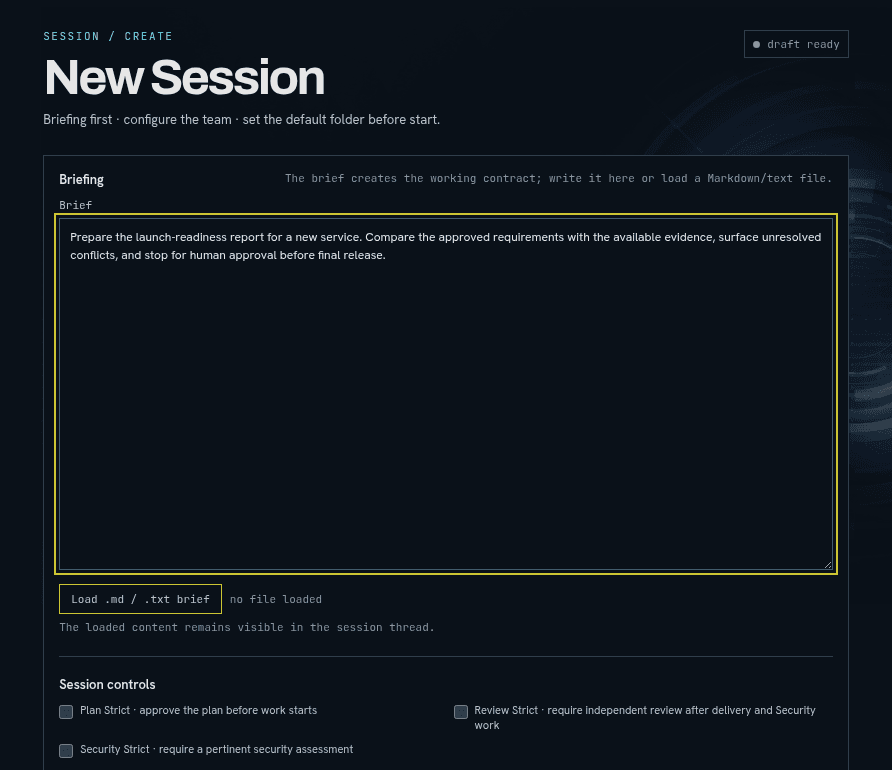
The New Session view brings the brief, working folder and approval controls together before execution begins, so the session starts with a defined scope and visible authority.
Start with Tandem
Create an account and put one real, long-running task through bounded work, separate review, human decisions and an inspectable closeout.